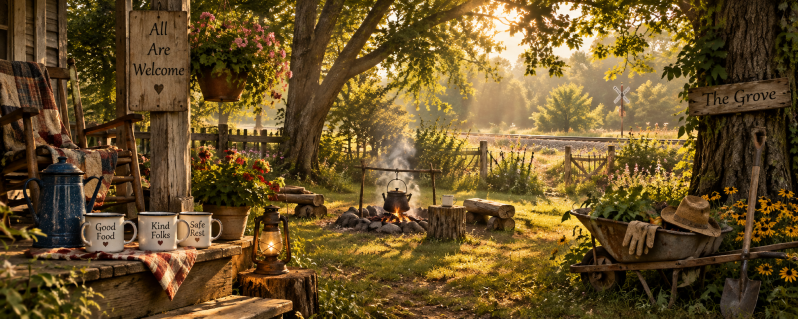
I grew up in the country, only about 10 miles outside of town
– but for all practical purposes, it could have been a million miles!
Daddy and Momma had 3 acres of land, ½ acre wide and 6 acres long.
The back of the place stopped at the railroad.
In all the times of working that land with my dad and Momma I saw the different markings on the trees and found a few ribbons of varying colors tied here and there.
I remember asking my dad about them, only to be told
– “Now don’t you worry about that. It just is.”
Later, I learned that my dad had been a hobo from the time he was about 12 years old until he married my Momma at 22.
Those markings were hobo markings.
One of my morning chores as a child, beginning when I was about 5 years old, whether it was a school day or not
– was to get up before daylight, go out to the front porch and count the hoboes in the yard.
That way, Momma would know what kind of breakfast to fix.
There were mornings when no one was there.
And a few mornings when there was only 1 or 2
Then, there was a morning when I lost count at 100!
Many mornings I was greeted by the smell of a campfire that had been carefully built in the driveway,
the hoboes gathered around it,
with coffee and their sweet fire bread cooking in a metal coffee can.
I would count the hoboes, saying “good morning” as I made the count.
Go back to Momma in the kitchen, give her the count
– and help her get breakfast started.
While she finished breakfast it was time to do the chores for the morning.
Feed the cow, pigs and chickens
– gather the eggs, draw up water from the cistern for the day.
Momma had one rule for the hoboes –
“If you don’t work, you don’t eat a hot meal.”
She never turned anyone away, but if they did not do something to help
– they would get a cold biscuit and a glass of water.
If they worked, doing whatever there was to be done, it meant a full breakfast
– eggs, meat, homemade biscuits, gravy, potatoes, and with fresh hot coffee, or fresh milk.
Momma had 1 row in the garden that no one, but the hoboes worked
– whether pulling weeds, or watering, or picking the vegetables.
And she had 1 flowerbed that was the “hobo bed”
– no was allowed to weed it except the hoboes.
Often, one or more would help me with the morning chores
– always a welcome and appreciated time!
After chores, I would serve their breakfast and sit on the porch with them.
I enjoyed listening to their stories or having one read to me.
More than one played Barbie dolls with me or held my baby doll while I refilled their coffee cup.
I remember the stick dolls that some made for me.
I was shown the pictures of their little girls back at home
– and told that I reminded them of their little one.
I remember one hobo had a thick Scottish brogue, and he loved to talk or sing.
Many told me of their travels
– where they had been, and what they had seen.
I was gifted many little pocket treasures through the years.
On very rare occasions, one would be rude or hateful to Momma.
Before she had a chance to call them on it, one of the other hoboes would handle it
– and the one being rude or hateful was escorted off our place, with a stern warning to never return!
My favorite afternoons were when a hobo or 3 would be waiting on the porch when I got off the bus.
They listened to my day, helped with my homework, listened to me read and spell.
And afterwards, they helped with my chores!
The day the railroad closed the tracks was a sad and heavy day for Momma and me.
I was about 15.
After growing up those 10 years with these treasured souls, it was a difficult transition to make for them not to be there again.
Memories are precious
– and I am so thankful for those years with the hoboes.
I learned a lot from them and the life I grew up in –
1. People are not their worst day.
2. Dignity matters more than comfort.
3. Work is not punishment, it is participation.
4. Stories are currency
5. No one is invisible unless we choose to make them so.
6. Being attentive is more important than can be realized.
7. People need structure with Mercy.
8. Pain does not disqualify someone from the table.
9. Absence equals loss, but life goes on.

Add comment
Comments